How we can properly call art “science" — Part 3

The previous post of this three-part series examined why experimentation and prototyping are key to the scientific method, especially where public art is concerned. Building on that idea, this post insists that prototyping is most valuable when it's documented in a shareable form.
Art is science when its creation is documented with the goal of sharing knowledge.
When we think about the art world, this is certainly not the common practice. This challenge begs the question: what if the interpretive labels displayed alongside works of art began to incorporate more information relating to how the object was created?
Many museums have taken comparable steps to rethink and rewrite their labels, making the text more comprehensible to diverse audiences, crafting fictional narratives to engage visitors for longer periods of time, and leaving curatorial interpretation open to interpretation by inserting turns of phrase, such as seems to be. Providing the backstory to a work of art—that is, information about the prototypes that led to what it is you’re looking at in the exhibition setting —whether in an analog fashion or via digital engagement platforms like apps, serves a different end. It serves a scientific approach to art.
We’ve come to expect the authoritative interpretation of art to be placed on a placard on a wall, just as we’ve come to expect scientific experiments to be communicated first and foremost in an academic journal article. But there are other ways and forums through which we can communicate knowledge about the experiments that lead to what we call art and, likewise, what we call science. These ways and forums prioritize meeting the public at some point between the act of making and theoretical engagement. What can we expect of these forums, though, when the art we find has no walls for labels? Here’s a straightforward—and familiar—example to start us off.
Blogging
The artist Lucy McKenna’s work can generally be described as inspired by science. As the first post in this series pointed out, this is typically the surface layer of what we think of when we think of scientific art. Since we now know better, we can look for other tell-tale signs of the scientific method in how McKenna presents her work. Is there any experimentation involved? How does she document that process? And to what end?
Consider McKenna’s most recent project The Artist Observatory (2016). On her website, McKenna explains that as an artist in residence at a space observatory, she became interested in what is called dry plate astrophotography—for the most part, a now-dormant practice. To see if she could make her own photographs using this procedure, she researched the methods and experimented with various materials (both new and old).

Moreover, she documents the details of her process on a separate blog, accessible via a “Process” link on her website. Here are just a few notable excerpts from a series of posts on The Artist Observatory that help to assemble a complete picture of how art can be developed through transparency with respect to experimentation:
I [received] my expired Kodak and ORWO plates, dating from the 1960’s and 1970’s, so I’m looking forward to testing these over the coming weeks to find out if their emulsion is still active and if I can use them to make my own astrographs. (McKenna 12 Mar 2016)
I began building the dry plate camera to fit the Grubb telescope this week...The next step from here will be exposing my 4 different batches of dry plates to light to see if their emulsion is still active at all, then hopefully making my way back to Armagh Observatory with them on a clear night to try photograph some stars and planets with this camera. (McKenna 11 Apr 2016)
I turned my bathroom into a darkroom this weekend...I took 2 plates from each batch and cut them down quite small. I tested these in daylight, tungsten, and on longer exposures in almost darkness using the Ernemann Heag II plate camera and recorded the conditions in my notebook. (McKenna 24 Apr 2016)
McKenna’s research and creative process were inextricable. Mark Ratto of the University of Toronto calls this theoretical and pragmatic form of engagement critical making. Conceptual thinking and physical making are, to Ratto’s point, often held separate. However, the constructive process of making can be a site for analysis as well (2011). Documentation demonstrates that objects and materials carry ideas. Grounding these ideas in critical discourse accredits them as knowledge worth sharing. In McKenna’s case, she accomplishes this by connecting her documentation to history and other scholarly literature.
Blogs are a great way to share such reflections as well as informal records of procedure. But when an artist wants to share codified knowledge in a form that lends itself more directly to further experimentation, platforms like Github, Thingiverse, and Instructables are more fitting. These platforms can be categorized under the umbrella of open access repositories.
Publishing on Open Access Repositories
Github, Thingiverse, and Instructables make it possible to openly share code, designs, and do-it-yourself project guides. They can be seen as infrastructure supporting not only artists but also open science/research/data initiatives. Open access refers to online research outputs (scientific, data-centric, or otherwise) that are made directly accessible to the public free of charge and without delay or other barriers.


The connection between art and science may not be as readily apparent in the connection between these repositories and open access. However, it can be rationalized in light of the scientific merit of documenting artistic experimentation. Here’s another way to put it.
The open-access projects pictured above could have been used to create works of art, and by being made available on an open access platform—a public forum, essentially—it becomes possible for other artists, makers, or scientists to repeat the process of creation. In doing so, they would be experimenting with the replicability of the initial experiments that produced the project made accessible to the public in the first place. In other words, they would be confirming the knowledge established by the first use of a particular experiment. Thus, they’d be creating art scientifically and it would be possible for them to do so because documentation had been shared.
This is what happened when New American Public Art appropriated the Low Poly Mask uploaded by the user kongorilla onto Thingiverse to create the first prototype of Your Big Face. By publishing their remix, they’ve provided a resource for further iteration.
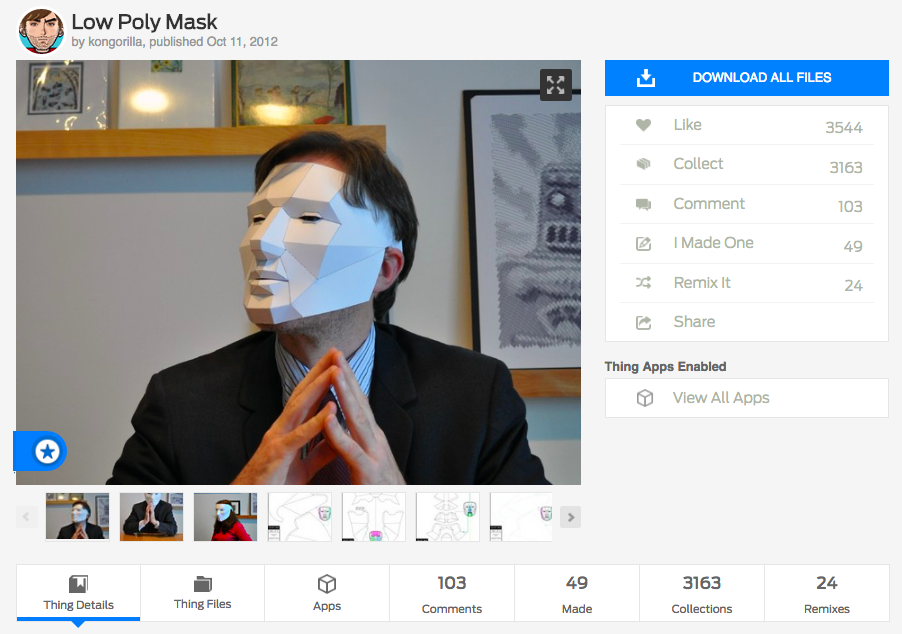
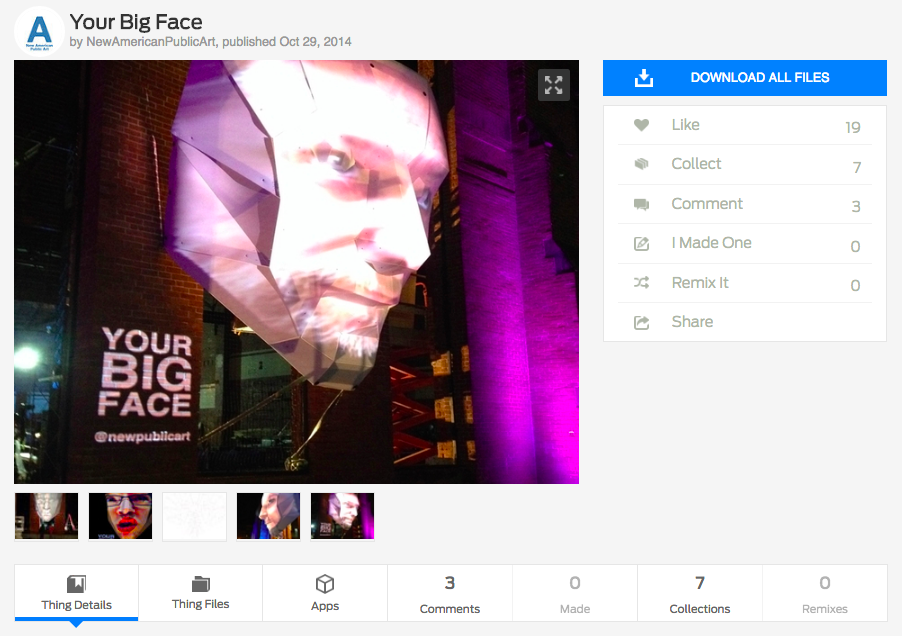
Leaving conceivable but outmoded apprehensions about revealing the inner workings of the artist’s mind aside, there are two matters of concern worth discussing in relation to open access—something that happens to be very important to us here at NAPA. The first has to do with accreditation, which I explored from another angle in a previous post on the technological mediation of public art. The second has to do with resources, which I will briefly address here. First, a word on Creative Commons to bring our discussion on attribution back to the fore.
Creative Commons
Open access overcomes traditional notions of copyright in many ways, allowing secondary users to share and build open documents, for instance. Creative Commons specifically allows people (creators/licensors) to share their work openly “in the commons” while getting credit for it by retaining certain copyright laws. These laws require anyone who makes a “remix” to make their iteration available under the same terms. There are few actionable repercussions for those who do not abide. Creative Commons excels when it comes to enabling good actors, but we can’t expect it to discourage bad ones just as effectively. It gives permission but not necessarily protection. All in all, it permits—even encourages—experimentation to lead to credible knowledge. It’s an adaptation of scientific citation standards for the arts.
Interestingly, the Creative Commons site currently has both a header and a footer with calls for contribution.
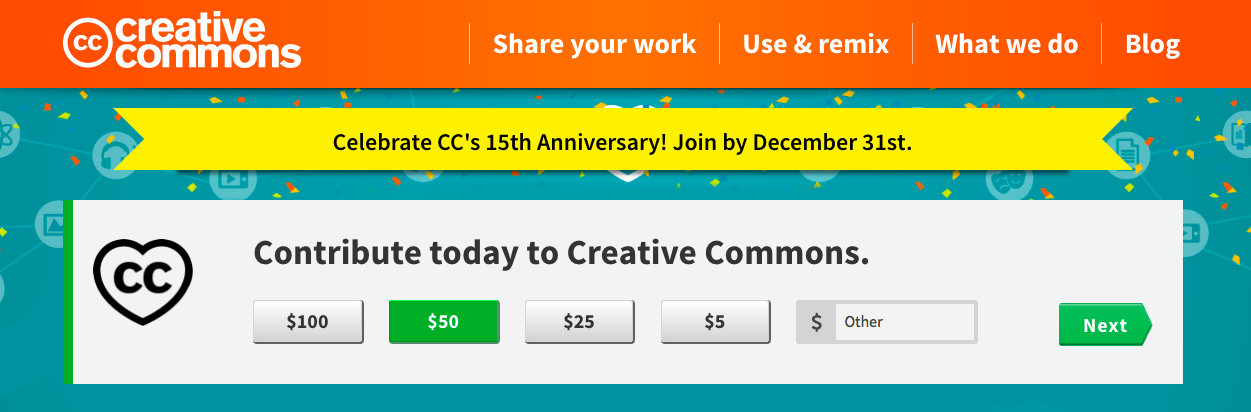
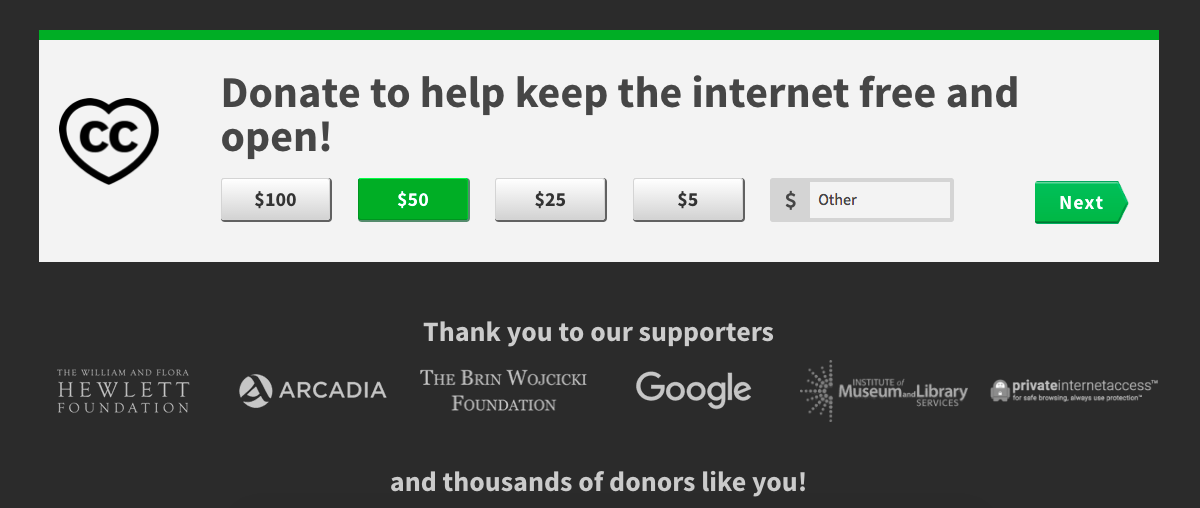
You’ve likely seen the same on Wikipedia at one time or another. That’s because making something “open” doesn’t exempt it from needing resources to prove sustainable. The fact that open access repositories of all kinds need resources is the second matter of concern relative to providing open access documentation. Documenting experiments properly with the intent of sharing them takes time, effort, and funding.
Patreon
Patreon is a platform that allows creators to crowdsource funding. This might seem antithetical to open source, but while open source may hold ‘free’ as a tenet, that’s not to say that there are no costs to make the resources it distributes. Artists can use platforms like Patreon to make documenting experimentation a more feasible endeavor. This is the goal of New American Public Art’s Patreon page, which contends that public art should be a public resource. You can pledge to be an “Investigator” or “Material Researcher,” too.

The scientific connotations here are not coincidental, but indicative of what it means to aspire to transparent documentation and replicable experimentation. The fact that costs are associated with making knowledge accessible doesn’t need to be hidden, and, by the same token, fundraising doesn’t need to act as a paywall for codifying experimentation in other open access repositories. It can, rather, just act as way to hasten and sustain the process.
In sum,
The documentation of prototyping is undoubtedly one very important aspect of critical making. It is typical for such documentation to be done by the artist, scientist, or researcher (when it’s done at all), but I would be remiss to not mention that documentation can be enacted by a secondary party. For instance, cultural theorists who take up projects like McKenna’s The Artist Observatory as their objects of study also contribute to the network of documentation that surrounds the project. Whether or not secondary documentation is any less scientific is a topic for another discussion.
In anticipating further discussions that may branch off from here, it would be advantageous for us to contemplate additional questions: how big does the forum that accesses and accepts knowledge need to be in order for that knowledge to be considered science? How can we expand the cultures of trust from which repeatable experiments may be derived? What role can platforms and tools like blogs, open source repositories, Creative Commons licenses and crowdfunding play to replace or transform the interpretative labels we’ve come to expect as accompanying art? With public art as our concern, such questions as these are key. By finding tenable answers, we can work towards meeting the public in a more accessible space between art and science.
How we can properly call art “science" — Part 2

When we call art ‘‘experimental,’’ the loose implication is that it is innovative or avant-garde. We’re primed to wonder what makes it radically different. But we can also start to think about whether or not an “experimental” work is a prototype (or derived from one) and consider what makes it a test of some hypothesis.
The dictionary defines the word prototype as “an original model on which something is patterned.” A prototype does not necessarily need to be fully functional or ready to be copied. It does, however, need to challenge assumptions and set new goals or redefine existing ones. Like experimentation more generally, it is a way to proof concepts, unsettle assumptions, and learn from mistakes.
Prototyping is essential for public art, which needs to be engineered to hold up against the elements of the environment, the whims of the public, and its own construction.
When thinking about the role of the scientific method in creative development, prototyping is key. Yet, the idea that something creative can originate from the scientific method is more generally agreed upon in the field of design than it is in the sphere of art. This is because the latter is typically esteemed for being expressive and coming from some internal place, while the former is subjected to precise constraints and measurable objectives—usually by some outside party. In either case, though, when the thing being created needs to stand up to some kind of pressures—having to do with user experience (UX) and structure, for example—there is a strong chance it will take shape as a prototype first.
Art is science when it embraces prototyping
With art, there’s a variable scale of being able to anticipate whether something will come out right the first time or only upon the tenth try. Prototyping to get to that optimal version can consist of user-experience testing. It can also consist of experimenting with materials. Moreover, prototyping is essential for public art, which needs to be engineered to hold up against the elements of the environment, the whims of the public, and its own construction. Some of New American Public Art’s case studies provide evidence for this claim. Here are two stories from the archive that demonstrate—in New American Public Art’s words—to build is to know.
Prototyping through UX feedback
Between a Mirror and a Memory challenges our abilities of self-recognition and our assumptions of the present moment. Viewers encounter a monitor featuring a live video feed with a temporal delay. The delay is timed to create a cognitive disconnection, yet remain intimately familiar. Viewers are faced with observing their “selves” from the near past, but just beyond immediate memory. They react to their reaction, which they will in turn perceive again. The experience exists in the slippery space between past and present moments, recognition and unbelief, and between the self and the other. (NAPA 2015)
The effect achieved by Between a Mirror and a Memory was not one that could have been achieved with accuracy on the first try. It went something like this:
Hypothesis: watching a live feed of yourself that’s slightly delayed is unsettling Prototype: set up a video system with a variable temporal delay First Iteration: a one-second temporal delay Result: people feel like they’re watching themselves in a glitchy Skype session Second Iteration: the temporal delay is adjusted to sixty seconds Result: people feel like they’re watching a fragment of a home movie Third Iteration: the temporal delay is adjusted to eight seconds Result: User Experience: people feel like they’re apprehending themselves just beyond immediate memory Conclusion: An eight-second delay is the sweet spot; people describe the experience as “ a continual feeling of déjà vu that you’re unable to catch up with.”

Prototyping and experimentation in Between a Mirror and a Memory revealed temporal links between our attention spans and our self-conceptions just beyond ‘real-time’. The result relied heavily on user-experience testing. Many of NAPA’s other projects rely less on UX testing and much more heavily on prototyping with materials and structures. Thought Follows Action is one notable example.
Prototyping through material lessons
Thought Follows Action was the culmination of NAPA researching Buckminster Fuller’s geodesic structures and instructing a class on fabricating them at the Artisan’s Asylum makerspace. During the course of the class, when approached by TEDx Somerville for an iconic entrance piece for their conference, NAPA decided that the geodesic sphere—which can be scaled to be very large without requiring much material—made perfect sense.
Experimenting with small-scale geodesic domes in the class had revealed that the structures could be made relatively easily out of an open framework of triangles bolted together at their vertices, constructed out of thin plywood strips or out of EMT pipes.

Made out of either material, when two spheres of varying sizes are nested and connected by rope, they can be spun, creating a kinetic sculpture. Masonite tileboard was selected as a replacement for plywood to fit within the budget allotted by TEDx, but fabricating large spheres out of masonite offered some valuable lessons for materials testing. Namely: "it is the first use of a particular experiment that establishes new knowledge – the replications are intended to confirm it" (Macdonald and Basu 2008).
Hypothesis: masonite tileboard is a suitable material for building large geodesic spheres Prototype: build a masonite sphere with a five-foot diameter Result: the structure holds up—the entire weight of the five-foot sphere can be supported while resting on the ground on any of its triangular vertices First Iteration: build a second masonite sphere with a nine-foot diameter Result: the material begins to crack under its own weight, and only remains intact when suspended off the ground from reinforced steel hubs Conclusion: at a scale somewhere between five feet and nine feet, masonite is no longer a suitable material for building geodesic spheres

Soon after TEDx, NAPA received a grant to remake Thought Follows Action for a juried, outdoor art exhibit in Chapel Hill, NC called Sculpture Visions. During this second experiment, they tested another material.
Hypothesis: EMT pipes are a suitable material for building nine-foot diameter geodesic spheres Prototype: build a geodesic sphere out of EMT pipes with a five-foot diameter Result: the structure holds up incredibly well, supporting the weight of an entire person

Second Iteration: build a nine-foot diameter geodesic sphere out of EMT pipes Result: the structure holds up Conclusion: EMT pipe, though methodologically more challenging to work with, is better suited than plywood or masonite for building geodesic spheres with diameters larger than five-feet

This case clearly demonstrates: “It’s worth reflecting that tensions and fractures and glitches of all sorts reveal opportunity” (Nowviskie 2015). It also illustrates how cases that allow for temporary art installations to be repeated allow for further experimentation and learning.
As the next post in this series will demonstrate, all experimentation and results—much like sources of inspiration—should be documented in a shareable way. This makes it possible for confirmed knowledge to be distributed and appropriated for further iteration. Put another way, experiments can be seen as having an exhibitionary quality and scientific documentation can be understood as a permutation of the writing on the wall of the gallery.
In sum,
The prototype—the system formed to test an initial hypothesis— serves as a basis for further iteration through which artists can determine whether the work holds up to their expectations, experientially and structurally.
Our plea for scientific experimentation in the arts includes documentation of the process of prototyping. This post sets a minimal example of what we, here at NAPA, mean by this. Admittedly, it’s a tall order to ask for art to be systematically pursued, unambiguously described, transparent with respect to evidence and method, and aimed at producing communicable knowledge. Therefore, Post 3 of this series will provide examples of platforms and practices that make it easier.