How we can properly call art “science" — Part 1

Today, few artists explicitly use the scientific method, but that doesn’t impede the public from perceiving certain works of art as being more ‘scientific’ than others. To preserve the integrity of science, however, it’s necessary to spell out the terms we use to define it.
we should not fall victim to embracing red herrings which are dressed up like science.
Our definition of science at NAPA:
Science is the intellectual and practical activity encompassing the systematic study of the structure and behavior of the physical and natural world through observation, hypothesis formulation, experimentation, documentation, and publication (Oxford Dictionaries). Furthermore, the term science is synonymous with ‘the scientific method’, and should be regarded as an act, not a field. In short, science should be understood as a mode of inquiry and an approach to the production of knowledge.
Based on these terms, disambiguating what leads us—the public—to readily but uncritically call art ‘science’ is a matter of testing our initial impressions against the scientific method.
This sentiment is the catalyst behind this first post of a three-part series on art & science that hinges on the premise: art that people claim to be a product of science should be accompanied by evidence that justifies that claim.
Adhering to procedure
We’ve all seen it before—a sea anemone vase, a charcoal drawing of cell walls, a work of art that claims to be science but is in fact just a work of art inspired by science.
The Canadian blog “Art the Science” reinforces the common misconception that art can be science without resulting from science in action. Each of their posts that features an interview with a creator opens with the same question: “Which came first in your life, the science or the art?” The responses reveal that plenty of artists who engage with science or work under its guise do so thematically but not necessarily methodologically. The likes of “Art the Science” prompt us to look for science in subject matter but not to question procedure.
Another “Art the Science” interview question discloses a second underlying assumption regarding the way science permeates art (even though the blog’s title suggests it will disclose the reverse). “Which materials do you use to create your artworks?” communicates that science can be found in media, or tools and technology. As a case in point, the “Art the Science” blog unintentionally shines light on some ways we’re tempted to settle for thematic and technological fragments of science in art, without the expectation of finding science itself.
What we need to remind ourselves is like every other form of knowledge, science is constructed through particular procedures. The next post in this series will address how science can be properly employed to create art, but, for now, let’s dismantle the very enticing trap of equating science with technology.
Calling technology into question
“Art the Science” is not an isolated example of editorial that potentially leaves readers feeling as though they’ve just learned about some great new piece of ‘scientific art.’ Take for instance, the article “7 Ways Technology is Changing How Art is Made,” published on Smithsonian.com in 2014. Here is an example it showcases:

Like the other six examples, this work gives off an air of being very scientific; it incorporates environmental stimuli, gadgetry, and data. These three things can, of course, be understood in scientific terms. But so can all other objects or media that we find incorporated into art. Paint can be understood in the scientific terms of chemistry, and yet this does not make the paint an indicator of science, as defined above. Thus, we should not fall victim to embracing red herrings which are dressed up like science.
All art created by means of technology can be said to reflect on or have been inspired by science. That doesn’t mean that it was necessarily derived from the scientific method. When Morozov shares the documentation of the prototypes that led to this working device and formulates a statement regarding what it makes evident about pollution in Moscow, then we can call his project both art and science with conviction.
A more classic example of this art/science/technology quandary can be found in the medium of photography. When it was invented in the mid-nineteenth century, it was a technological wonder—artistically and scientifically.

Now, photography is an agreed-upon art form. And certainly, there is a science behind how the camera captures an image, but only a portion of photographs serve to interpret science in action.
Therefore, employing technology as a tool is not the same as using science as a method.
This distinction is wonderfully illustrated by the documentary film Tim’s Vermeer, which follows the inventor Tim Jenison’s efforts to prove that the photographic quality of the 17th-century Dutch painter’s masterpieces could be attributed to Vermeer having mechanical help.

Even if the conclusion that Jenison draws in the film is correct (and it would seem that it is), calling Vermeer’s paintings ‘scientific art’ wouldn’t be accurate according to the criterion of communicating documented methodology. It’s haphazard to use the word science to describe the effect of technology upon art.
Science is a mode of inquiry
In Tim’s Vermeer, Jenison follows the scientific method when he replicates Vermeer’s approach. Jenison wonders how Vermeer was able to achieve such a photographic quality in his paintings. From reading David Hockney’s Secret Knowledge and Philip Steadman’s Vermeer’s Camera, he hypothesizes that Vermeer used a mirror to monitor parts of the picture. He then builds a prototype to test this theory. After he and Steadman produce impressive oil paintings of a vase using only the technique without any classical education in the fine arts, Jenison sets out to test whether he can reproduce one of Vermeer’s famous paintings using the same procedure. He recreates the physical scene with all its objects, and during the process of painting he is able to observe how the mirror produced some anomalies in Vermeer’s work that could only be attributed to its intervention. Analyzing the final painting, Jenison, Steadman, and Hockney all draw the same conclusion—Vermeer’s sleight of hand was aided by mirrors.
In light of this, we should begin to hold artists, curators, and critics accountable when they assert that artistic objects are scientific. Only what artists do—not what they create or what they use to create it—can be called science. Vermeer’s paintings are not scientific, but Jenison’s efforts to replicate them are.
In sum,
The steadfast way to argue that a work of art can be categorized as science is not to evoke subject matter or technology, but to take account of whether or not the artist used the scientific method. Through Tim’s Vermeer, we see that science is a mode of inquiry and an approach to the production of knowledge that is made explicit. Moreover, as a form of research and knowledge production, science is defined in large part by its stake in experimentation.
The discourse around art generally lacks any reference to the scientific method, so in the remaining posts of this series I will demonstrate what experimentation looks like for artists and what we should expect documentation to entail.
What is Interactivity?
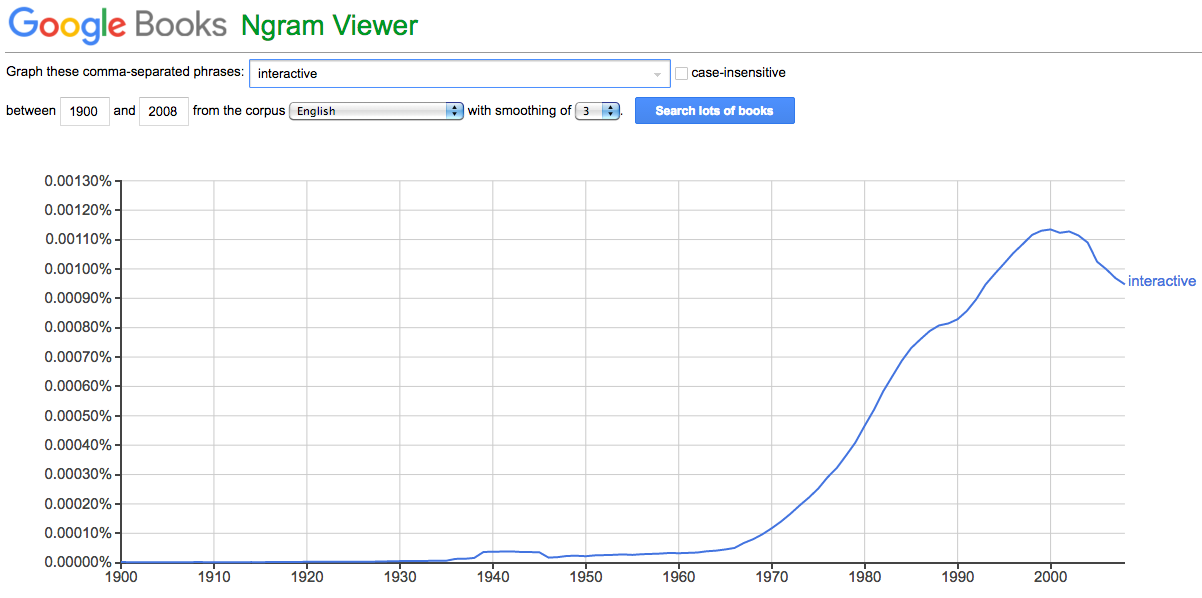
Interactivity is a relatively recent term that remains obscured by common usage. To put this into perspective, a quick search of interactive in the Google Books Ngram Viewer yields the following graph:
This graph is interesting because it parallels the increased alliance between art and technology from the 1950s onward. This alliance ushered in a new age of interactivity—one that becomes apparent when considering the emergence of television and video art in the 60s, for instance. Closed circuits made spectators integral to works of art in arguably unforeseen ways, and in doing so they required new descriptive words such as interactivity.
I believe we are in need of somethingmore than input in order to qualify what happens in an encounter with art as interactivity.
Given that my background in art history consists of knowledge of art post-World War II, this graph—while both interesting and revealing—is for the most part predictable. I say this because analog computing began to rise to prominence and be adopted by artists in the 50s, overwhelming support was given to the technological arts by backers such as Bell Labs in the 60s, and then—jumping ahead—interest in virtual reality experienced a rush in the 90s. Yet, for all its predictability and for all my familiarity with practices that have been loosely called interactive, I cannot give you a straightforward definition for the word. My hunch is that many others have stumbled over defining interactivity too and have opted for other words or descriptive phrases to use in its place as of late.
So, what do we mean when we say that something is interactive? And, in the realm of art, what may that something consist of? There are a number of examples and strata to be considered.
The spectrum of action & ‘live’ art
Unless we’re prepared to go down a philosophical rabbit hole, we typically do not regard the experience of viewing a painting in a museum as an inter-active one.
The painting is, by contradiction or negation, a categorical case of non-interactivity.
In our encounter with a painting we can say we are, at most, active as interpreters. When the object of visual art is a sculpture, we can describe our experience of it as being slightly more active than our experience of a painting, as we are enticed to walk around it. Put it outside, and we might even be drawn to touch it or climb on top of it. But, traditionally, in the gallery, what we see, we don’t touch; there is no inter to our action.
There is by contrast a significant amount of contemporary art that does invite our touch or, alternatively, our gesture. Much of it even goes one step further and responds to that physical input. Contemporary art of this kind is typically (but not necessarily) characterized as interactive by its use of software, or technology more generally. Therefore, addressing an example that involves both corporeality (or corporeal literacy) and human-computer interaction is essential.
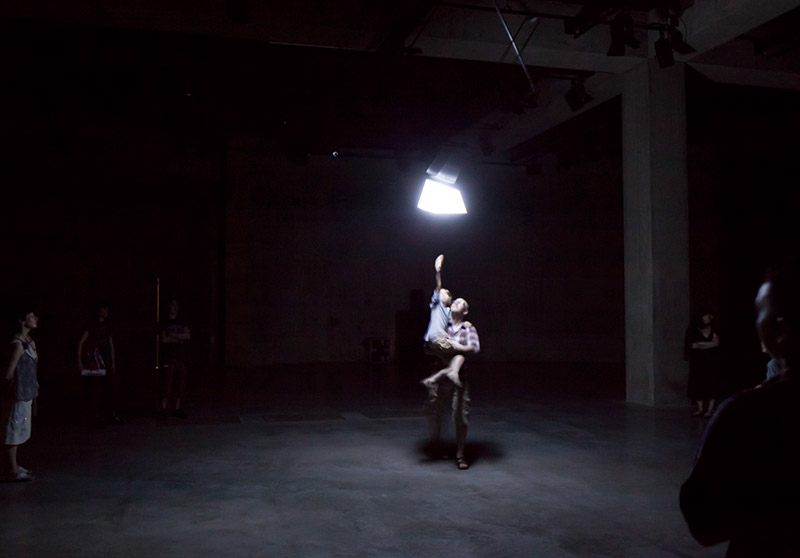
Opposing the painting on the spectrum of interactivity is Ruairi Glynn’s Fearful Symmetry, an installation featuring a glowing tetrahedron that some would say “dances” with members of the audience. Glynn used an array of Kinect cameras—among other devices and materials—to create Fearful Symmetry, which was commissioned by the Tate Modern to inaugurate the London museum’s new ‘live’ art space, The Tanks, during August of 2012. FearfulSymmetry brings together robotics, interaction design, and gesturerecognition algorithms into an event of puppetry in which both the tetrahedron and its visitors take turns being the metaphorical puppets and puppeteers.
Participation as a governing factor
In between these endpoints — that of the painting and the robot puppet—there is a spectrum of other aesthetic works or practices that can be described as interactive with varying tenability. This spectrum has been theorized by computer art pioneers Stroud Cornock and Ernest Edmonds (1973) as consisting of the following categorizations or strata. Given the extensiveness and precariousness of what can be called interactive art, I take these to be neither mutually exclusive nor all-encompassing.
(a) The static system—the art object is unchanging, as is any traditional painting.
(b) The dynamic-passive system—the art object changes with time by the artist’s program or by factors in the environment; Dutch artist Theo Jansen’s wind-powered sculptures are great illustrations of this kind of system.

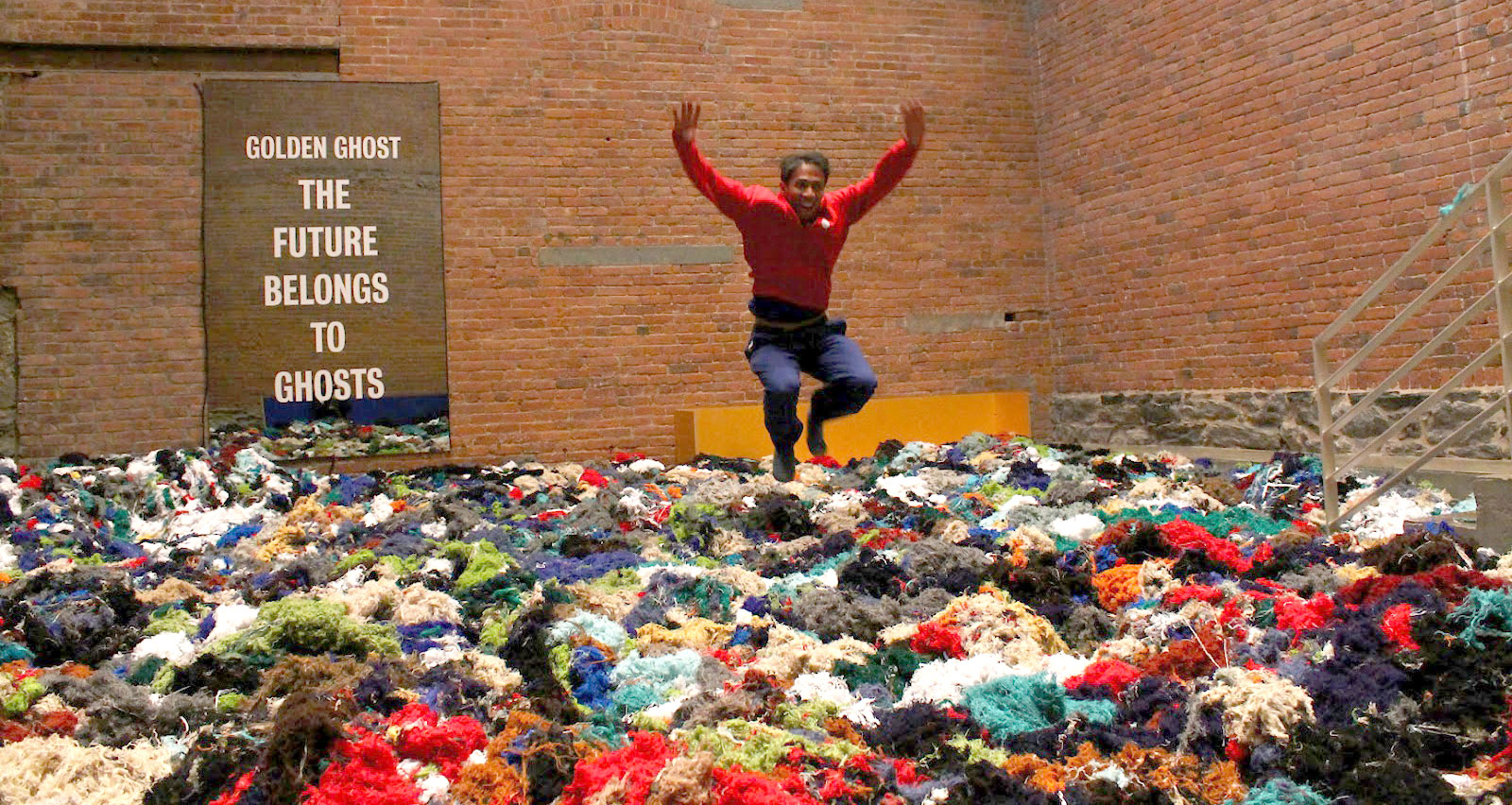
(c) The dynamic-interactive system—the art object is participatory: that is, it accommodates input from the participant. Many of Jeffrey Shaw’s installations, which are part kinesthetic and part digital or virtual, make an obvious case for such a system, but technology isn’t a necessity, as is demonstrated by Surasi Kusolwong’s participatory work which emphasizes social engagement.
(d) The dynamic-interactive (varying) system—a network in which the conditions of (b) and (c) apply, with the additional condition that the art object’s behavior can be changed through the modification of system specifications by a human or software agent (Schraffenberger & van der Heide 2012). This last strata is the most complex. It helps to imagine a dynamic-interactive (varying) system as capable improvising via learning & adaptation rather than just following a script.
With all the above strata in mind, it is possible to qualify the painting as “static” and Fearful Symmetry as “dynamic-interactive (varying),” with the varying element being Glynn’s behind-the-scenes team of software puppeteers who programmed the robot’s responses in real-time when they saw appropriate. The case of Fearful Symmetry is, however, a curious one. When deprived of human participants, we would expect the glowing tetrahedron to revert to being a static system rather than one which responds to factors in its environment.
Interactive public art, even when it uses strikingly similar mechanisms, functions differently.

A dog that runs in front of NAPA’s Blue Hour, like an unaware passerby, would technically elicit a response by activating motion sensors. It would, nonetheless, evoke the timeless thought experiment: "If a tree falls in a forest and no one is around to hear it, does it make a sound?" In other words, just because something is responsive doesn’t mean it’s interactive. Without establishing a feedback loop, an art object that affords participation but does not embrace that participation as a governing factor is not interactive. Carsten Höller’s functional playgrounds nicely expose this lack.

The supposed interactivity of augmented reality (AR) should hypothetically fit into the spectrum outlined above. However, because the categorization of AR is complicated by the possibility of considering either or both the augmenting interface and the objects in its real space of operation as the art object(s) or system(s), AR warrants a discussion of its own.
(Not) placing a finger on the concept of interactivity
While Cornock’s and Edmonds’ array of interactivity may help us plot contemporary art on a graph of interactivity based on the degree of human agency afforded, I believe we are in need of somethingmore than input in order to qualify what happens in an encounter with art as interactivity. And what that interactivity consists of is in need of conceptualization, not definition or distribution.
To put it another way, the spectrum explained above is in need of a conceptualization of interactivity that’s not wholly invested in a demonstration of technology’s mediating capabilities, but interested in the technology’s tweaking of lived experience and the reciprocal effect of that experience on technology—a back and forth of action and reaction. Thus, following Brian Massumi, I believe:
What is central to interactive art is not so much the aesthetic form in which a work presents itself to an audience—as in more traditional arts like painting, sculpture or video installation art—but the behaviour the work triggers in the viewer. The viewer then becomes a participant in the work, which behaves in response to the participant’s actions. Interactive art needs behaviour on both sides of the classical dichotomy of object and viewer. (2008)
One would not be wrong to interpret Massumi’s use of the term behavior, as having human(e) connotations. What Massumi is describing suggests that we forgo speaking of paintings, wind sculptures, and kinesthetic design when speaking of interactivity, and instead embrace works, objects, or systems that surprise us with properties that surpass mimicry and formulaic response with unexpected but relational feedback, as in Fearful Symmetry. In other words, the experiencer and the art object or system together should co-govern the interaction.
The something left to be desired
All in all, I think that the something more we need in a contemporary conceptualization of interactivity may be immediacy of presence (as in, let’s get rid of mediating interfaces that dilute our access to the object). Or some kind of communication—even coordination—which necessarily supposes a possible feedback loop that is predicated on a perpetual state of transitory open-endedness. This would make possible the emergence of otherwise unattainable properties that would make the happening a complete and iterative, but non-repeatable whole. And perhaps what that something entails, then, are the qualities of an event—a singular but passing occurrence that “has an arc that carries it through its phases to a culmination all its own: a dynamic unity no other event can have in just this way” (Massumi 2011). In this sense, I see installation art as advantaged, because it demarcates a special place in time and space.
Moreover, in any event of interactivity, I would expect not only social interaction among human participants, but also a mediating object—imaginably, with a liveness of some kind—that makes the event or the experience possible in the first place. Drawing from the artistic impulses of the 60s, this is a conceptualization of arelational aesthetics, but with technology at its center. It is a conceptualization that shines a light on the engineering of experience where engineering retains its mechanical connotations without manipulating human agency in such a way as to reinforce the subject-object binary. In this aesthetics, gestural and physical modalities are preferred over representational or linguistic ones, solely on the basis of their dynamism. For public art, an interactivity like this is key, because:
For art to switch its role from the private, exclusive arena of a rarefied elite to the public, open field of general consciousness, the artist [has] to create more flexible structures and images offering a greater variety of readings than were needed in art formerly. (Packer & Jordan 2002)
With a greater variety of readings, there may be greater chance for meaningful improvisation. And with this, we cannot go without reconceptualizing our notion of the artist in this approach to interactivity: it’s no longer necessary to assume that he or she has a particular craftsmanship, rather he or she is “a catalyst of creative activity” (Cornock & Edmonds 1973). As Bruno Latour (1996), speaking of puppetry, puts it:
If you talk with a puppeteer, then you will find that he is perpetually surprised by his puppets. He makes the puppet do things that cannot be reduced to his action, and which he does not have the skill to do, even potentially. Is this fetishism? No, it is simply a recognition of the fact that we are exceeded by what we create.
The art of public art critique
Simply put, a problem persists: artists, policy makers, and foundations involved in the creation of public art are often subjected to critiques that resemble the ones written for gallery openings.

A problem exists: public art is often critiqued using gallery-art standards. These standards do not consider the changing social and physical contexts of the public realm, which heavily influence the impact of a work. Thus, new methods of critique must be investigated to critically, fairly, and effectively evaluate public art.
for public art, controversy shouldn’t necessarily mean success.
The article “Responsible Criticism: Evaluating Public Art,” written for Sculpture in 2003 by art historian Harriet Senie, puts this problem into context. Many of Senie’s suggestions are worthwhile, but others construe public art into what it is not—art curated for a museum or gallery. Two of these misguided suggestions deserve our attention.
Misguided Statement #1: Controversy means success
According to Senie, “public art attracts critical attention only when it is the subject of controversy.” This has historically been the case witha variety of pieces, such as with Seward Johnson's Forever Marilyn.

Writer Heba Hasan points out that this sculpture was criticized for its anti-feminist connotations and vandalized numerous times, and notes that “the monument didn’t exactly reflect the city’s character or engage positively with its community” (2012).
We face an unfortunate future if public art needs to attract negative attention to foster intellectual engagement. Where art is concerned, attention of some kind is appreciated whether or not your venue has walls. But as the positive press reviews for Candy Chang’sThe Atlas of Tomorrow (pictured above)demonstrates: for public art, controversy shouldn’t necessarily mean success.
Misguided Statement #2: Politics and philosophy are nonessential
In her article for Sculpture, Senie also argues in favor of using the term audience instead of public. She asserts that public implies a larger political or philosophical concept, whereas audience directs attention to the immediate passersby of an installation or intervention—those for whom it was created. Senie’s preference for the term audience is problematic. It clashes with the reality that when someone encounters public art, they are not a passive spectator, but cast as a protagonist.
This could mean that the values and history of the individual’s community are represented in the work. It could also mean that his or her participation is required to bring the work to life. In either case, the individual who encounters the work is in some way empowered. He or she comes to stand—politically as well as philosophically—for the larger public for whom the work was designed.

To justify this interpretation of “Responsible Criticism” as one way to read public art reviews more critically, we need to answer the question what is public art.
Drawing from participatory movements in art history
One possible way to configure a working definition of public art is to trace some of its roots back to the Situationists International,an avant-garde movement of artists, intellectuals, and political theorists that rose to prominence between 1957 and 1972. The Situationists denounced advanced capitalism along with its commoditized objects and spaces. They advocated instead for directly lived experiences that could facilitate social interaction.
Speaking of the ways that the Situationists artfully diverted the inaccessible features of urban space, Professor of Architectural and Urban History Simon Sadler writes:
Each constructed situation would provide a decor and ambiance of such power that it would stimulate new sorts of behaviour, a glimpse into an improved future social life based upon human encounter and play [...] It would clearly be some form of performance, one that would treat all space as performance space and all people as performers. (Sadler 1998, 105)
This description highlights some worthy measures of success for public art:
- an appeal to aesthetics
- the improvement of social conditions
- the activation of human agency
Public art that upholds these qualities has likely been designed with the community in mind, and it deserves a stamp of approval.
Thinking of ‘good’ public art as enabling the public to act in particular ways brings to mind a notion of art that is tied to civic engagement. For civic engagement or civically-minded interaction to happen effectively, public art and the space where it's installed needs to be accessible.
Accessible, communal spaces admit or afford particular sets of habits. Many of these habits follow democratic rights such as the freedom of speech or assembly, making public art inseparable from politics. If public art is so controversial as to inhibit any of these rights, it is frankly ‘bad public art.’ No matter how much critical attention it attracts.

All this considered, there's an advantage in learning to be wary of reviews that use artworld standards to assess public art. Rather than see it as a subset of the classical art institution, we now have a critical insight to regard public art for what it really is: the interdisciplinary space between aesthetics and civic engagement.