Public Art in the Age of Technological Mediation

In 2015 the city of Portland, Oregon celebrated the thirtieth birthday of its landmark statue Portlandia. But despite Portlandia’s iconic status in the city and in the world—as the second largest copper statue—there wasn’t much of a party. And you won’t find her image on postcards or souvenirs. Though she’s located in public space, Portlandia’s maker Raymond Kaskey retains commercial rights to the piece, and thus has veto power for duplication or re-creation of related images.
Reference guidelines are loosely obeyed and copyright infringements difficult to catch.
Art has always had to address problems of attribution and authenticity. The Information Age has only complicated this. And the situation becomes even more muddled when the artistic object in question is presumed to be public. Yet, not all public art stakeholders would take Kaskey’s side in a debate over copyright infringement. There is, after all, a notable difference among ubiquitous documentation (Instagram photos and the like) and documentation for press, merchandising, and what I’d call records of fact. With that in mind, Portlandia raises some important legal and philosophical points for debate.
What are the merits of copyright vs the freedom of panorama?
According to “The Intellectual Property Wiki” on Gettyimages, “As a general rule, places that charge an admission fee or require a ticket for entry usually require special permission for commercial photography.” Following this, it would be reasonable to assume that no permission is required when that place is accessible without a fee or ticket. Not according to federal copyright law.
U.S. copyright law gives the copyright holder—in our case, the artist—the exclusive right to produce derivative works, including photographs. The matter of photography is not black and white, however. Parts of the law automatically protect works that are fixed on or in ‘tangible mediums’—murals on walls, for example. Distinctions and exceptions are also made based on how photographers use the images, how much of a work they capture in the frame, and which creative elements of the original work they bring to their adaptation.
In Europe, the situation differs. The Freedom of Panorama, which was recently upheld by a vote in the European Parliament, maintains that the public has the unrestricted right to use photographs of public spaces showing copyrighted structures without infringing on the rights of the architect or visual artist. In the United States,freedom of panorama means you may freely take photos of permanent buildings and use them how you please, but you cannot do the same with photos of copyrighted artworks and sculptures. The EU’s Freedom of Panorama is not as important for protecting selfies as it is for allowing the uninhibited depiction of public spaces within educational records.
Where do we draw the line between works of art or records of fact?
Photographs can be characterized either way, but when we’re talking about a photo of a work of public art displayed on Wikipedia there’s little chance that the reader would assume that Wikipedia created whatever work of art they are depicting. In this case, a photograph of a work has been appropriated for public knowledge sharing. There’s certainly something commendable about that as far as public art is concerned—particularly when appropriate credit is given to the artists.

In many other cases, credit isn’t given where and when it’s due. Think of editorial content that cites the photographer of a work of public art but fails to mention the actual artists. In an odd turn of events, the appropriation is deemed more reputable than the original. Perhaps this is an unavoidable side effect of the technological mediation of objects in the form of images. Reference guidelines are loosely obeyed and copyright infringements difficult to catch.
Art housed in private institutions is privileged in this respect; they have more ownership over the information that contributes to art’s authenticity. Not only is a Van Gogh more clearly and reliably a Van Gogh in a museum, but as the International Network for the Conservation of Contemporary Art puts it:
Artists often cooperate with conservators to integrate their works into the [museum] collection properly. This collaboration results in documentation that is specific to the installation and forms the basis for the display and management of the work.
When the artist collaborates in the process of documentation, that documentation becomes a work of art in and of itself. Whether public art should operate differently and concede ownership to public appropriation is a relevant question without a definitive answer.
What does ‘liveness’ have to do with public art documentation?
When we talk about the conservation of public art, we can be referring to its physical preservation but also to how it may or may not be possible to conserve its presence through technological mediation. By presence I mean the simultaneous physical presence of the artwork and the public in the same space and moment of time.

Professor of performance and technology, Steve Dixon, identifies two conflicting views in cultural studies concerning the photograph’s claim to preservation and liveness. On the one hand, there’s Walter Benjamin who argues that when an artwork is mechanically reproduced, its presence is diminished. Benjamin writes, “Even the most perfect reproduction of a work of art is lacking in one element: its presence in time and space, its unique existence at the place where it happens to be” (Dixon 2007). On the other hand, there’s Roland Barthes who considers photography a means to making the reality of the past live again. He contends that “every photograph is a certificate of presence” (Dixon 2007); rather than being fabricated ‘copies’ of reality, they are authentications. Pics or it didn't happen.
I imagine Barthes’s point of view is appealing to conservationists and documentarians of temporary public artwork. After the work is uninstalled, we have no choice but to rely on multimedia documentation to get an idea of how it may have been experienced (see Christo & Jeanne Claude’s famous Gates). To Benjamin’s credit, though, participation or interactivity cannot be saved. When it’s re-presented, it becomes something else altogether.
Today, photography isn’t a standalone form. We have a multitude of methods to document interactivity. For all these methods may be worth, they’ll ultimately fall short of replicating the live event. Naturally, with this, the problem of ownership remains.
What, then, should we make of the technological mediation of public art?
Ubiquitous documentation, regardless of its original intent, represents an end to seeking permission. With this, there’s a renewed need for attribution to be given where it’s due and for public artists to consider how ‘public’ they want their art to be. Tools including Creative Commons & initiatives such as Open Source validate this as a pressing issue. If someone in another country wants to own a reproduction of a piece of public art that they’ve never seen in-person—to meet the original halfway, as Benjamin puts it in “The Work of Art in the Age of Mechanical Reproduction” (1970), why should an image of that work—or even the code and hardware used to make it—not be ‘public’ for them?
Maybe all modes of presence wherever the artwork and public meet and whether live or mediatized now need to be regarded on equal grounds. Where a commitment to access is concerned, we need policies which uphold the trend that art’s public and art’s reach has been extended beyond the physical and the now.
At New American Public Art, we don’t have an easy solution for this attribution quandary just yet. We seek a way to make public the process of making public art. We could learn from our interdisciplinary colleagues: perhaps the answer lies somewhere in between the practical reference style of scientific papers and the completionist listing of film credits.
The art of public art critique
Simply put, a problem persists: artists, policy makers, and foundations involved in the creation of public art are often subjected to critiques that resemble the ones written for gallery openings.
A problem exists: public art is often critiqued using gallery-art standards. These standards do not consider the changing social and physical contexts of the public realm, which heavily influence the impact of a work. Thus, new methods of critique must be investigated to critically, fairly, and effectively evaluate public art.
for public art, controversy shouldn’t necessarily mean success.
The article “Responsible Criticism: Evaluating Public Art,” written for Sculpture in 2003 by art historian Harriet Senie, puts this problem into context. Many of Senie’s suggestions are worthwhile, but others construe public art into what it is not—art curated for a museum or gallery. Two of these misguided suggestions deserve our attention.
Misguided Statement #1: Controversy means success
According to Senie, “public art attracts critical attention only when it is the subject of controversy.” This has historically been the case witha variety of pieces, such as with Seward Johnson's Forever Marilyn.

Writer Heba Hasan points out that this sculpture was criticized for its anti-feminist connotations and vandalized numerous times, and notes that “the monument didn’t exactly reflect the city’s character or engage positively with its community” (2012).
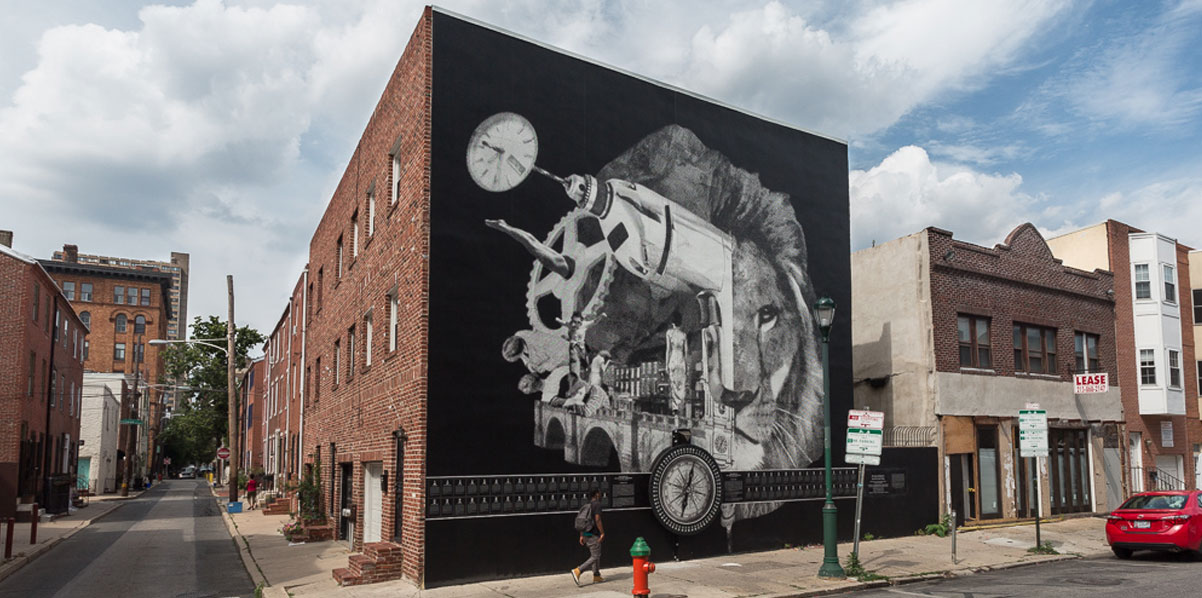
We face an unfortunate future if public art needs to attract negative attention to foster intellectual engagement. Where art is concerned, attention of some kind is appreciated whether or not your venue has walls. But as the positive press reviews for Candy Chang’sThe Atlas of Tomorrow (pictured above)demonstrates: for public art, controversy shouldn’t necessarily mean success.
Misguided Statement #2: Politics and philosophy are nonessential
In her article for Sculpture, Senie also argues in favor of using the term audience instead of public. She asserts that public implies a larger political or philosophical concept, whereas audience directs attention to the immediate passersby of an installation or intervention—those for whom it was created. Senie’s preference for the term audience is problematic. It clashes with the reality that when someone encounters public art, they are not a passive spectator, but cast as a protagonist.
This could mean that the values and history of the individual’s community are represented in the work. It could also mean that his or her participation is required to bring the work to life. In either case, the individual who encounters the work is in some way empowered. He or she comes to stand—politically as well as philosophically—for the larger public for whom the work was designed.

To justify this interpretation of “Responsible Criticism” as one way to read public art reviews more critically, we need to answer the question what is public art.
Drawing from participatory movements in art history
One possible way to configure a working definition of public art is to trace some of its roots back to the Situationists International,an avant-garde movement of artists, intellectuals, and political theorists that rose to prominence between 1957 and 1972. The Situationists denounced advanced capitalism along with its commoditized objects and spaces. They advocated instead for directly lived experiences that could facilitate social interaction.
Speaking of the ways that the Situationists artfully diverted the inaccessible features of urban space, Professor of Architectural and Urban History Simon Sadler writes:
Each constructed situation would provide a decor and ambiance of such power that it would stimulate new sorts of behaviour, a glimpse into an improved future social life based upon human encounter and play [...] It would clearly be some form of performance, one that would treat all space as performance space and all people as performers. (Sadler 1998, 105)
This description highlights some worthy measures of success for public art:
- an appeal to aesthetics
- the improvement of social conditions
- the activation of human agency
Public art that upholds these qualities has likely been designed with the community in mind, and it deserves a stamp of approval.
Thinking of ‘good’ public art as enabling the public to act in particular ways brings to mind a notion of art that is tied to civic engagement. For civic engagement or civically-minded interaction to happen effectively, public art and the space where it's installed needs to be accessible.
Accessible, communal spaces admit or afford particular sets of habits. Many of these habits follow democratic rights such as the freedom of speech or assembly, making public art inseparable from politics. If public art is so controversial as to inhibit any of these rights, it is frankly ‘bad public art.’ No matter how much critical attention it attracts.

All this considered, there's an advantage in learning to be wary of reviews that use artworld standards to assess public art. Rather than see it as a subset of the classical art institution, we now have a critical insight to regard public art for what it really is: the interdisciplinary space between aesthetics and civic engagement.